LAS VEGAS — As artificial intelligence agents rapidly evolve from simple conversational tools into autonomous economic actors capable of executing commercial transactions, merchants are facing an unprecedented operational dilemma. Major enterprises attending last week’s Money20/20 conference in Las Vegas revealed a growing defensive posture: many are blocking AI agent traffic entirely. This drastic measure stems from a fundamental structural vulnerability in modern digital commerce—merchants currently lack a reliable, cryptographically secure method to verify who actually authorized a purchase initiated by an AI agent, leaving businesses trapped between outright blocking and absorbing severe fraud and chargeback risks.
To address this pressing bottleneck, the Circle Internet Group (NYSE: CRCL) and identity infrastructure firm Proof used the Money20/20 stage to unveil a collaborative breakthrough. The companies demonstrated how verified legal identity and stablecoin payments can be seamlessly combined into a single, agent-initiated transaction. By marrying cryptographic identity verification with instant blockchain settlement, the new framework provides merchants with the verifiable trust they need to safely welcome autonomous AI commerce rather than locking it out.
How the Protocols Fit Together
The technical architecture behind the collaboration relies on two open HTTP-layer standards designed to operate in sequence. Proof’s x401 protocol, which was originally published in June and moved into official production last week, leverages the standard HTTP 401 "Unauthorized" response code. Through this mechanism, a merchant can programmatically specify precisely what identity proofs it requires and which trusted credential issuers it recognizes when an agent attempts to initiate a purchase.
Simultaneously, Circle’s x402 protocol utilizes the HTTP 402 "Payment Required" response standard to dictate how the AI agent must settle the financial transaction. When deployed together, the dual-protocol stack creates a seamless handshake: the x401 protocol answers the critical question of who the agent acts on behalf of, while the x402 protocol handles the mechanics of how the transaction settles.

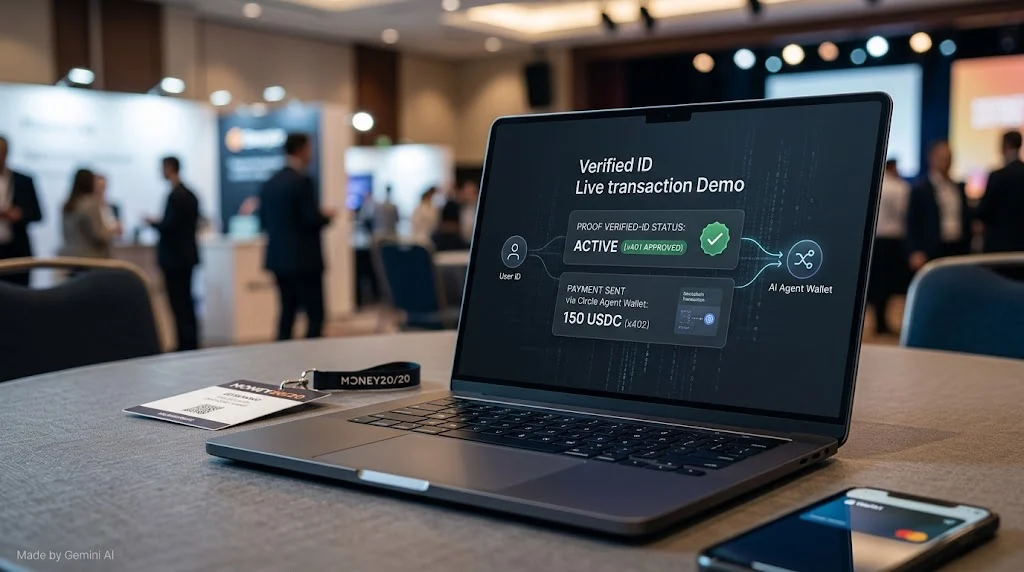
During the live demonstration at Money20/20, the interaction played out in a streamlined sequence. When an inbound agent request reached a merchant’s system, the server responded with both an x401 identity requirement and an x402 USDC payment request. In response, the AI agent’s Proof wallet presented a verified credential derived from identity proofing certified to the rigorous NIST IAL2 standard, accompanied by a cryptographically signed, purchase-specific approval.
Crucially, the architecture preserves user privacy through data minimization. Only the relevant identity facts necessary for the transaction are disclosed to the merchant; no raw identification documents are transmitted, exposed, or stored on the merchant’s servers. Once identity is verified, the agent executes the payment from a Circle Agent Wallet using USD Coin (USDC) over the x402 channel. As a result, the merchant retains signed, tamper-evident evidence verifying who authorized the transaction. This audit trail can be deployed directly in dispute resolution scenarios without requiring Proof to be queried again in real time.
Beyond solving identity verification, the protocol stack introduces a secondary commercial mechanism of notable significance. Because Proof prices individual identity claims separately, the integrated x402 payment channel is capable of routing an instantaneous micropayment from the merchant directly to the identity issuer for each verification check performed. This capability eliminates the cumbersome bilateral contracting requirements that have historically hindered the reuse of verified identity across disparate digital ecosystems. Instead of negotiating complex prior sales relationships, a merchant can simply pay for an identity check on the spot, precisely at the moment the verification is required.
Pat Kinsel, founder and chief executive of Proof, highlighted the strategic importance of the collaboration at the conference. "Our demo with Circle shows one exchange can answer both questions: verified identity from Proof and payment in USDC," Kinsel stated. "That gives businesses a reason to say yes to agents instead of blocking them."

Market Context and Regulatory Read-Across
The timing of the Circle and Proof collaboration is particularly pointed. Industry discussions at Money20/20 underscored a rising commercial tension, with several large financial institutions and merchants reported to be blocking AI agent traffic entirely to protect themselves from liability. However, this defensive posture carries an escalating commercial cost as consumer adoption of AI assistants and autonomous shopping tools accelerates across global markets.
The joint framework from Proof and Circle represents one of several competing initiatives attempting to establish standard protocols for agentic identity. It arrives alongside emerging work within the World Wide Web Consortium (W3C) verifiable credentials ecosystem, as well as proprietary agent-authentication layers developed independently by major payment networks and cloud computing providers.
From a regulatory standpoint, anchoring the protocol in the NIST IAL2 credential standard carries substantial weight. The NIST framework is widely referenced in United States federal identity guidelines and is rapidly gaining traction in broader Know Your Customer (KYC) discussions as a reliable benchmark for remote identity proofing. International parallels exist as well; in the United Kingdom, the Digital Identity and Attributes Trust Framework published by the Department for Science, Innovation and Technology outlines comparable compliance requirements. This alignment suggests that a credential meeting IAL2 standards could eventually secure formal recognition in cross-border trade and verification contexts.
Furthermore, the European Union’s eIDAS 2.0 digital wallet framework similarly defines rigorous trust levels against which x401-style identity presentations could eventually be evaluated. Despite these technical alignments, whether regulatory bodies will ultimately accept protocol-layer identity assertions as fully satisfying strict KYC obligations under anti-money laundering (AML) regulations remains an open question. This regulatory evolution will heavily influence how rapidly traditional financial institutions can adopt native agent-payment flows, or whether they will continue to route such transactions through legacy, human-authenticated customer channels.