The American household has long served as the bedrock of the national economy. It functions as both an engine of growth—hauling a full third of the nation’s GDP—and as the heroic protagonist in a perpetual narrative of American dynamism. Household formation, population growth, and the pursuit of homeownership have historically propelled business investment, spurred innovation, and laid the foundation for community development. For generations, the progression of the American life cycle—young adults leaving home, forming relationships, establishing households, and eventually passing the baton to the next generation—has defined the rhythm of our economic life.
However, this progression has never been universal or equally attainable. Despite that, the assumption that more households would consistently form, grow, and prosper has remained the fundamental premise upon which businesses, investors, and policymakers build their long-term strategies. But today, that foundational logic is facing a quiet, seismic challenge. What happens when the American household, still central to the nation’s economic future, no longer behaves as expected? What occurs when families shrink, birth rates decline, and the population ages?
These are the questions that now demand a radical shift in "mental furniture"—a necessary rearranging of the deeply held assumptions regarding where American economic growth originates and what will sustain it. For homebuilders, residential developers, land investors, and their capital partners, the implications of these shifting demographics are especially profound.
The Myth of the Perpetual Cycle
Leaders in the housing industry are well-versed in the language of cyclicality. Successful operators have spent their careers navigating interest-rate volatility, economic contractions, credit disruptions, and the classic ebb and flow of supply and demand. They understand that business resilience—or even better, antifragility—is not about perfectly predicting the next downturn. Instead, it is about building the strategic and operational capacity to adapt when conditions change.
Yet, a new, structural reality is emerging that may not be solved by a simple pivot or a wait-and-see approach. While artificial intelligence is currently dominating headlines by forcing leaders to rethink labor, productivity, and organizational value, demographic change operates on a different, more glacial timescale. Its effects often hide in plain sight, but for an industry that makes capital commitments and land investments meant to bear fruit five, 10, or 20 years into the future, these consequences are every bit as transformative as any technological revolution.
Unlike the cyclical disruptions that have historically corrected themselves following an interest-rate cut or a surge in consumer sentiment, a sustained transition toward flat or declining population growth is a permanent shift. It cannot be counted on to reverse with a change in the business cycle.
Confronting the Demographic Reality
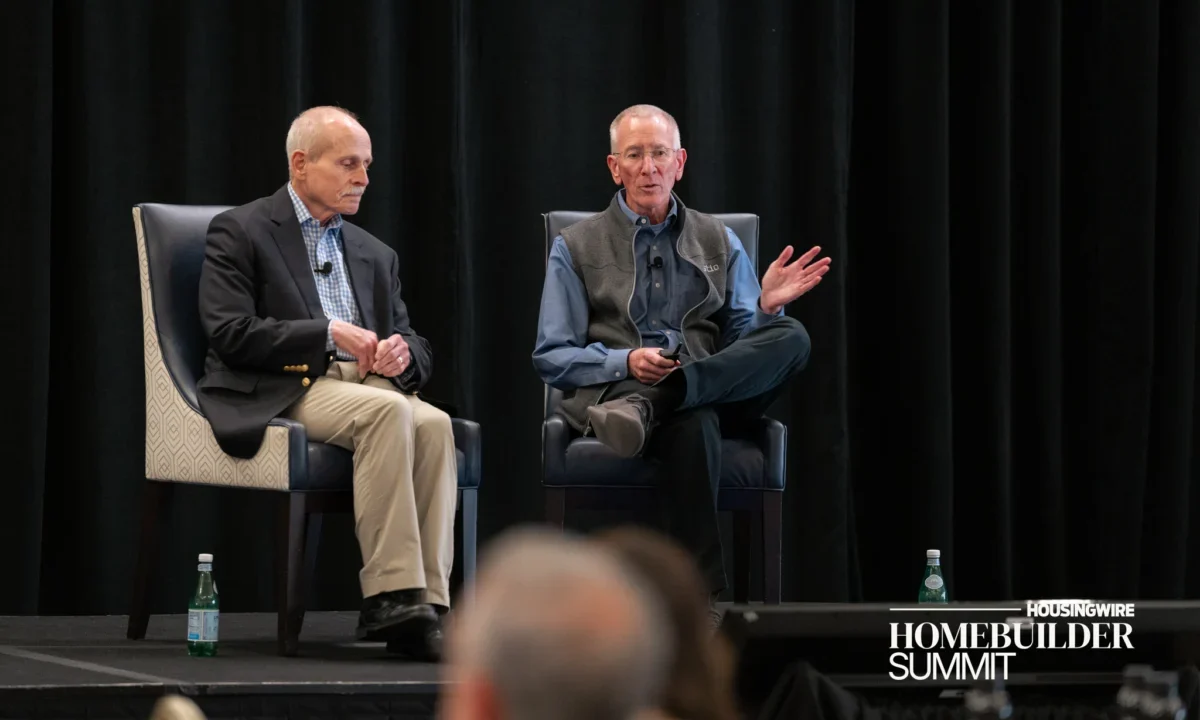
This sobering reality was the focal point of a recent presentation at the HousingWire Homebuilder Summit in Dallas. Scott Cox, principal at SLC Advisors, and Steve Friedman of CohnReznick, delivered a session titled "Is Demographics Destiny?" that challenged executives and investors to confront evidence that the industry’s long-standing demand assumptions are no longer fit for purpose.
The data presented paints a clear, if sobering, picture. The outlook points to a sharp slowdown in household formation, with future growth increasingly concentrated among Americans over the age of 75—a demographic segment that is statistically less likely to purchase newly constructed homes. Furthermore, the combination of declining birth rates and an increasing reliance on immigration creates a volatile landscape for the 2030s and beyond. Should immigration levels become a counter-growth variable, or should births continue to fall below the rate of deaths, the demand conditions that homebuilders have relied upon for decades will be fundamentally altered.
The impact of this shift will not be uniform. Some metropolitan areas may continue to attract investment, while others stagnate or contract. Even in high-growth markets, the competitive landscape is shifting; as opportunities become more scarce, the industry may find itself in a position akin to a group of people fighting over a smaller campfire. For an industry that has long treated household growth as a reliable, perpetual tailwind, the difference between a cyclical shortage and a structural shift is monumental.
Navigating a Changing Landscape
As executives look toward the next decade, the question is not whether the new-home market will disappear, but rather how it must evolve to remain profitable. Cox and Friedman suggest that the industry’s most valuable preparation begins with a willingness to abandon the assumptions that fueled previous successes.

A primary concern is the way builders manage land. Historically, the industry has relied on owning land as a core strategy, but today’s market demands a shift. Reducing land exposure is increasingly viewed as an immediate priority. By utilizing options, phased takedowns, and other arrangements, builders can maintain access to necessary inventory without assuming the entirety of the ownership risk. In an environment where land values may not always appreciate, shifting that risk is a critical survival mechanism.
Furthermore, the practice of underwriting land deals based on the expectation of future price escalation is becoming increasingly dangerous. For years, supply constraints supported rising home prices and residual land values even when volumes were low. However, if household formation slows, that relationship may break. Builders are now being urged to stress-test their acquisitions against scenarios where home prices remain flat or even decline.
The risk associated with long-duration master-planned communities also warrants a re-evaluation. While these projects have been a hallmark of the industry, they require massive, locked-in capital investments. In a less predictable demographic future, projects that can be adjusted in pace, product mix, and scale are inherently safer than those locked into a rigid, decades-long buildout schedule.
Building for a Different Customer
Beyond the financial and land-use strategies, there is the fundamental question of product. An aging, smaller population requires different housing solutions. While some developers have successfully captured profits by building independent-living facilities for other operators, there is also a need for smaller housing formats and accessory dwelling units. The challenge lies in meeting these needs without taking on unfamiliar operational risks or succumbing to the high costs of development.
This shift in strategy extends to the organizational level. Many homebuilding companies have been structured for perpetual, top-line growth, with systems, staffing, and overhead optimized for ever-increasing closing volumes. If the industry faces a future of flatter demand, these structures become liabilities. Companies must now model their performance at lower volumes, identifying where they can trim fixed costs and how they can generate returns without relying on constant expansion.
This also implies a change in leadership and talent retention. With fewer divisions or regional leadership roles available in a slower-growing industry, companies will need to find new ways to motivate and retain high performers. Relying on the promise of advancement through constant expansion is no longer a viable human resources strategy.
The Competitive Advantage of Preparedness
Ultimately, the goal of these strategic shifts is to foster a culture of adaptability. Cox and Friedman acknowledge that they do not have a crystal ball; they cannot say with certainty when the demographic shift will fully manifest or which specific markets will feel the brunt of the change first. Immigration policy, economic conditions, and internal migration patterns remain wildcards.
However, the lack of a precise timeline is not a justification for inaction. The next decade will likely reward a different set of capabilities: disciplined capital allocation, flexible production strategies, and the ability to find value in specialized, complex sites rather than relying on the easy, greenfield growth of the past.
The businesses that emerge as the most "antifragile" will likely be those that possess the courage to question the status quo. By decoupling their success from the assumption of endless, rapid growth, these companies will be better positioned to navigate the demographic headwinds of the 2030s. The industry is entering a new era where the ability to change course is just as important as the ability to build, and those who recognize this transition early will hold a significant, lasting competitive advantage.