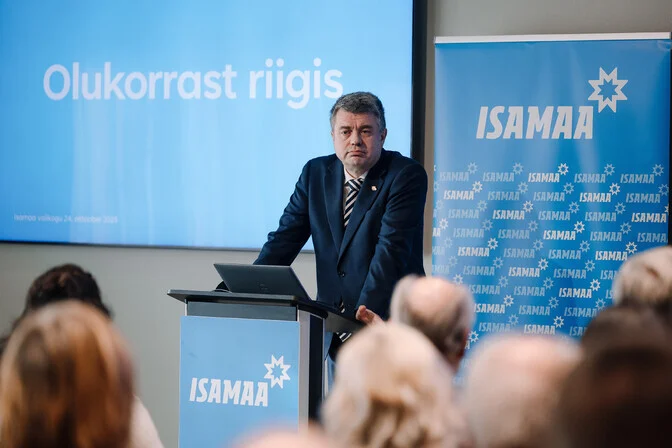
The race for Estonia’s next parliament has officially shifted into high gear, according to Isamaa leader Urmas Reinsalu, who used a high-stakes party council meeting in Tallinn to lay out a sharp critique of the current political establishment and unveil a sweeping, conservative-leaning platform for the upcoming 2027 Riigikogu elections.
Addressing party members, Reinsalu launched a blistering attack on the coalition parties and their allies, accusing them of orchestrating what he described as a coordinated "politics of lies." He pointed his finger directly at the Reform Party and Eesti 200—the core components of the current government coalition led by Prime Minister Kristen Michal and his predecessor Kaja Kallas—as well as the opposition Social Democrats. According to the Isamaa chairman, these three political forces, operating under the strategic guidance of the civil society organization SALK, are actively maneuvering to evade political accountability as the electoral horizon draws closer.
"Those same three parties that, under SALK’s leadership, have established a politics of lies under both Kaja Kallas’ and Kristen Michal’s governments are now maneuvering to escape political punishment and put up camouflage nets," Reinsalu declared to the party council.
The Isamaa leader went further, alleging that behind-the-scenes pressure is mounting to force Eesti 200 into a premature withdrawal from the electoral race. The calculus behind such a move, Reinsalu claimed, would be to channel the party’s remaining voter base toward bolstering the electoral fortunes of the Reform Party and the Social Democrats, thereby preserving the current political bloc’s grip on power under a different guise.
"So much for political accountability," Reinsalu remarked scathingly.
Turning his attention to the Reform Party’s broader electoral strategy, Reinsalu criticized the ruling party’s recent messaging, which he characterized as a renewed wave of fearmongering designed to distract from past governance failures. He noted that the political offensive has been wrapped in a polished marketing campaign—recently highlighted when advertising agency Tank stepped away from its apolitical streak to handle the Reform Party’s 2027 campaign preparation—with an underlying narrative that essentially admits past shortcomings while asking voters for a second chance.
According to Reinsalu, the Reform Party is attempting to soften its public image by featuring a beloved actor in its campaign advertisements. Meanwhile, he argued, the Social Democrats are employing a different tactical maneuver to distance themselves from their active participation and complicity in the Kallas and Michal cabinets. He pointed to recent reports that a top official from the Ministry of Foreign Affairs is being positioned to run as the Social Democrats’ candidate for prime minister in the upcoming 2027 elections. "This maneuver will not succeed!" Reinsalu asserted.
Having established his critique of the political landscape, Reinsalu pivoted to Isamaa’s own vision for Estonia following the March 2027 parliamentary elections, summarizing the party’s overarching philosophy with a straightforward demand: "Let the citizens decide."
To operationalize this principle, Isamaa has pledged to introduce significant democratic reforms, including granting Estonian citizens the legal right to initiate early elections, a mechanism inspired by the Latvian model. Furthermore, the party intends to establish a dedicated parliamentary commission of inquiry to investigate past governmental scandals once the elections have concluded. Under Isamaa’s proposal, providing false testimony before this investigative commission would be treated as a criminal offense.
On the critical front of national security and foreign policy, Isamaa’s platform takes a hardline stance by committing to the complete closure of the border with Russia. This security-focused posture is matched by a series of domestic economic proposals aimed at reining in public spending and rolling back measures introduced by the current administration.
At the heart of Isamaa’s economic agenda is a commitment to pass a supplementary austerity budget designed to cut government expenditures. Reinsalu emphasized that fiscal discipline must begin at the highest levels of government. The party’s cost-cutting proposals include reducing parliamentary and ministerial salaries, completely dismantling the Ministry of Climate, and conducting a rigorous, critical review of state-funded foundations and institutional subsidies.
Tax policy also features prominently in Isamaa’s electoral pledges. The party has promised to scrap the controversial motor vehicle tax entirely and to provide immediate relief at the grocery store by slashing the value-added tax (VAT) on basic foodstuffs—specifically meat, fish, milk, fruit, vegetables, and bread—down to 13 percent, effective July 1, 2027.
Business and enterprise owners can likewise expect a dramatically different regulatory environment if Isamaa comes to power. The party has pledged to put an end to what it describes as the ongoing harassment of the business community. As part of this commitment, Reinsalu stated that the Climate Act would be discarded, with the explicit goal of restoring investment certainty and providing a stable operating environment for Estonia’s resource-based economy.
In a nod to technological advancement, Isamaa promised to spearhead an artificial intelligence revolution with the same bold, pioneering spirit that Estonia once displayed when it built its acclaimed digital state. The stated goal of this initiative is to drive genuine productivity growth, boost exports, and simplify government operations, all while remaining vigilant about national sovereignty risks.
The party’s extensive domestic agenda also includes vows to protect fundamental freedoms, repeal unnecessary legislative and administrative restrictions, ease the financial and logistical burden of raising children for Estonian families, and safeguard the incomes of teachers.
Energy policy represents another major pillar of the Isamaa platform. Rejecting current trends that seek to phase out traditional fossil fuels rapidly, the party intends to place a renewed emphasis on domestic resources, chief among them oil shale. Isamaa’s platform guarantees that the national energy sector will be supplied with reliable, dispatchable generation capacity, utilizing domestic resources to ensure affordable prices for consumers. According to the party, all ongoing efforts designed to render oil shale-based energy production economically unviable will be brought to an immediate halt.
Rounding out their comprehensive program, Isamaa pledged to implement stricter legal requirements regarding the use of the Estonian language in public spaces, pursue a conservative immigration policy, and work toward restoring regional balance across the country as the official campaign march toward the March 2027 Riigikogu elections gathers momentum.