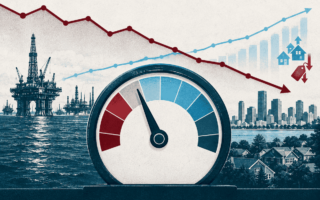
This past Wednesday, investors were braced for the typical volatility that often accompanies a Federal Reserve policy announcement. Yet, in what many dubbed an “October surprise,” the session proved to be eerily calm. Fed Chair Kevin Warsh appeared composed on the stage, delivering a message that leaned toward a dovish stance—provided that key economic indicators show the requisite improvement.
For many market observers, the primary takeaway was that the Federal Reserve remains steadfast in its desire to effectively "undo" the interest rate cuts implemented last year. By reversing those accommodative policies, the central bank aims to reset its position and gain a clearer assessment of the current economic landscape. While the ongoing geopolitical tensions in the Middle East and the persistent friction of "Trade War 2.0" have undoubtedly complicated the Fed’s mandate, Wednesday’s proceedings were largely viewed as a positive development. This sentiment is particularly notable given that, leading up to the announcement, markets were aggressively pricing in between five and six rate hikes, creating a high-stakes environment for investors.
At the time of the latest market check, the 10-year Treasury yield was sitting at 5.02%, retreating from earlier highs following a disappointing quarterly earnings report from Google. This cooling of yields provided a welcome buffer for equities that had been under significant pressure.
The Fed’s official press statement was uncharacteristically brief and straightforward, yet two specific elements stood out, signaling a shift in both tone and strategy that analysts are still dissecting.
The Semantic Shift: From “Solid” to “Strong”
The most notable nuance in the Fed’s language was the deliberate choice to describe the economy as "strong" rather than "solid." This was not a random vocabulary choice; it was a calculated signal. By elevating the descriptor, the Fed effectively communicated that it has no immediate intention to cut rates and, conversely, will continue to unwind the rate cuts of the previous year as long as inflation remains stubbornly above the central bank’s 2% target.
The statement explicitly noted: "Economic activity is expanding at a strong pace. While uncertainty remains elevated owing, in part, to geopolitical developments, domestic spending has been resilient."
During his press conference, Chair Warsh reinforced this outlook, pointing to jobless claims data that remain impressively low. His message was one of uncompromising commitment to the 2% inflation mandate. Furthermore, the Fed announced a structural change to its meeting cadence, signaling that it will hold one fewer voting meeting in 2027 and two fewer in 2028. While this may seem like a logistical adjustment, some analysts suggest it could grant the Fed more flexibility to implement larger, 50-basis-point adjustments—whether in the form of hikes or cuts—should the data necessitate a more aggressive response.
The Fed’s Stance on Market Volatility and the AI Bubble
There was a palpable sense during the proceedings that Chair Warsh was not entirely displeased with the recent tightening of financial conditions. The market has recently seen a shift in sentiment, particularly as some high-flying AI-focused companies have begun to face significant headwinds and a decline in valuation. This cooling off suggests that the market is beginning to price in the reality of a more restrictive interest rate environment.
In recent discussions, the narrative has shifted to the idea that the "AI god king" can indeed bleed, and if it can bleed, the market can recalibrate. Warsh appeared to lean into this sentiment, suggesting that no sector is truly invincible and that if market conditions become more restrictive, valuations must inevitably adjust. This is exactly what has been observed in recent weeks as capital markets have reacted to the reality of the Fed’s path.
Warsh also addressed the behavior of the 10-year yield, noting that it had "rolled over" despite the pressure of elevated oil prices throughout the month. The prevailing belief is that the rollover in the 10-year yield is primarily a market-driven phenomenon. Investors had previously priced in a much more hawkish Fed path than what was actually being signaled, causing the term premium on the 10-year yield to swell as it pushed toward its October peak.
Had the 10-year yield managed to close above the critical threshold of 5.35%, the implications could have been dire. Such a breach would have likely triggered a much more aggressive and rapid rise in bond yields, as the market would have been forced to price in an even more hawkish rate-hike cycle. Instead, the market showed restraint, choosing not to push into that higher-yield territory. It is clear that Warsh appreciates the fact that the markets are taking the Fed seriously; in many ways, the markets have already done the heavy lifting by tightening financial conditions, allowing the Fed to remain patient as it unwinds previous policy easing.
A curious side note during the meeting was the vote cast by Fed Governor Lisa Cook. Typically regarded as a dove, Cook voted in favor of raising rates. Many observers interpreted this as a tactical move, potentially a form of "trolling" in the context of the current political climate, particularly given that President Trump has previously expressed interest in launching a panel to investigate her tenure.
Implications for the Housing Market and Future Outlook
Ultimately, Wednesday’s news was a relief for many stakeholders. While the 10-year yield remains above the 5% mark, the fact that the Fed did not validate the extreme expectations of five or six rate hikes—all while navigating the ongoing geopolitical conflicts and trade wars—marks a victory for the month of October.
For the housing market, this outcome effectively averts the worst-case scenario. The Fed has, for the time being, provided the industry with some much-needed breathing room. This window of time is crucial, as it allows for the possibility of these external conflicts—the Middle East tensions and the international trade disputes—to reach a point of de-escalation.
The hope moving forward is that increased clarity on these two fronts will allow the Federal Reserve to calibrate its path more precisely. If the geopolitical and trade environments stabilize, the Fed can move toward a measured approach—a few targeted rate hikes—rather than a chaotic, reactive cycle.
The Fed has made its stance clear: it is focused on maintaining a strong economy while tethering inflation back to its target. With the markets now in a state of cautious alignment with the Fed’s objectives, the focus shifts back to the data. Investors, homeowners, and policymakers alike will be watching closely to see if the resilience of the domestic economy continues to hold, or if the "strong" growth the Fed describes will eventually necessitate further, more difficult, decisions in the months ahead. For now, the equilibrium has been preserved, and the path forward, while challenging, appears to be on a more predictable footing.