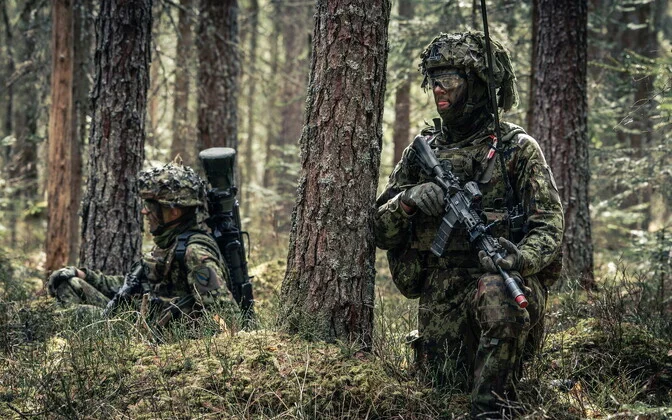
While wearing Estonian Defense Forces (EDF) uniforms and insignia without the legal right to do so is strictly prohibited under national legislation, these authentic military items can still be freely and easily purchased through online retail channels. The paradox highlights a distinct gap between the strict regulations governing the public display of military attire and the wide commercial availability of the garments themselves, a situation that continues to draw attention from national security officials and lawmakers alike.
Under the provisions of the Defense Forces Service Act, utilizing the official EDF uniform or its accompanying insignia without explicit authorization is entirely banned. The legislation treats such unauthorized use as a misdemeanor offense, granting the defense forces themselves the legal authority to pursue and investigate infractions. This regulatory framework was established to mitigate several significant risks, most notably the prevention of "false flag" efforts or deceptive operations during times of crises, national emergencies, or civil unrest. Additionally, the rules are designed to prevent cases of "stolen valor," a term commonly used to describe individuals who falsely claim military service or achievements by wearing uniforms to which they are not entitled.
The precise parameters of what constitutes a restricted uniform are established through a specific directive issued by the defense minister, which outlines every individual element and component of the official attire. Items such as a standard officer’s beret—which can be readily acquired through the shop operated by the volunteer Estonian Defense League, known as Kaitseliit—fall squarely under this protective description. Furthermore, a wide variety of camouflage items and field gear are readily available across numerous online stores. Civilian buyers can easily source summer scout caps, waterproof raincoats, standard-issue shirts, tactical vests, and other military surplus goods with minimal effort. In practice, authorities have received multiple reports of these uniforms being worn in public spaces by individuals who lack the legal right to don them.
Enforcement of these regulations falls under the jurisdiction of both the EDF and the Police and Border Guard Board (PPA). Officers from the PPA possess the authority to verify, out in public, whether an individual spotted wearing an EDF uniform is legally entitled to do so. Meanwhile, the EDF maintains the power to open formal misdemeanor proceedings whenever there is sufficient reason to believe that the established rules have been breached. Such investigations can be initiated based on actionable information received from the public or other agencies, or simply in situations where law enforcement or military personnel harbor a reasonable doubt regarding whether a particular wearer possesses the lawful right to don the uniform.
Despite these stringent public-wearing restrictions, the broader commercial landscape reveals a notable legal distinction. There is currently no direct legal ban prohibiting the mere buying or selling of such products within civilian circulation. Military surplus outlets, private vendors, and online marketplaces operate in an environment where retailing or producing these items does not require a special permit from the Ministry of Defense. Anyone with internet access and a credit card can navigate to various digital storefronts and purchase items that closely mirror, or precisely match, active-duty Estonian military gear.
At the same time, the line between legal commercial trade and illegal state property appropriation is clearly drawn when it comes to the origin of the garments. If a uniform or piece of equipment was directly issued to a service member by the EDF, it officially remains state property. Consequently, selling, trading, or otherwise transferring such state-issued property without explicit authorization is strictly prohibited. Moreover, the legal liability ultimately rests with the individual who wears the gear. The buyer of a standard EDF uniform or its official insignia remains fully liable under the law if they choose to wear it in public, regardless of whether the original seller possessed a permit to sell or whether the item was acquired through a commercial surplus channel.
The current legal framework is the result of deliberate legislative tightening. Back in 2021, the Ministry of Defense clarified that the civilian wearing of the military uniform was being explicitly banned because it represents official clothing worn strictly in the course of vital service duties, including active combat operations. At the time, the ministry emphasized that it was critical to ensure that any person seen wearing a military uniform—or clothing closely resembling it—who is not an active member of the military, could never be confused with a legitimate service member carrying out official duties.
For the EDF, maintaining this clear distinction is considered particularly vital during any period of crisis, heightened tension, or societal unrest. During such volatile times, the illegal wearing of military clothing could, either inadvertently or through deliberate malice, create a false and potentially dangerous impression regarding the actions, intentions, or deployments of the EDF, the Defense League, or the broader Estonian state. The underlying concern mirrors international anxieties surrounding the misrepresentation of military personnel, reinforcing the principle that the uniform represents a solemn public trust tied directly to national defense rather than a standard fashion choice or civilian commodity.